Today's
EarthStation1.com 15% Off Commemorative Memorial Title:
Appointment With Destiny: The Crucifixion Of Jesus MP4 Download Or
DVD
Today, March 28, 2026
March 28, 2026: Two Saturdays Before
Easter: -- Religion: The History Of Religion: Abrahamic Religions:
Christianity: Lent (Latin: Quadragesima, "Fortieth"):
Holy Week (Holy And Great Week, Passion Week): Lazarus Saturday:
-- Lazarus Saturday in Eastern Christianity (consisting of the
Eastern Orthodox, Oriental Orthodox, and Eastern Catholic
Churches) refers to the moveable feast before Palm Sunday to which
it is liturgically linked. It celebrates the raising of Lazarus of
Bethany. Bethany is recorded in the New Testament as a small
village in Judaea, the home of the siblings Mary of Bethany,
Martha, and Lazarus, as well as that of Simon the Leper. It is the
first day of Holy Week in Eastern Christianity; in Western
Christianity, the following day, Palm Sunday, is the first such
day. John's gospel reports that "Six days before the
Passover, Jesus came to Bethany, where Lazarus lived, whom Jesus
had raised from the dead." Presumably, it is where he spent
the Great Sabbath that occurs immediately before Passover, prior
to his triumphal entry into Jerusalem. Jesus is reported to have
lodged there during Holy Week, and it is where his anointing by
Lazarus' sister Mary took place a few days later on Holy
Wednesday. On Sale @ 15% Off Discount Till Midnight PT!
https://store.earthstation1.com/appointment-with-destiny-the-crucifixion-of-jesus-dvd.html
Today's
EarthStation1.com 15% Off Commemorative Memorial Title: The
Hermitage Museum World's Greatest Art Collections MP4 Download DVD
Today, March 28, 2026
March 28, 1483: #BOTD: #HBD! Raphael, Italian painter and architect of the High Renaissance (d. April 6, 1520) is #born Raffaello Sanzio da Urbino in Urbino, Italy. Raphael's work is admired for its clarity of form, ease of composition, and visual achievement of the Neoplatonic ideal of human grandeur. Together with Michelangelo and Leonardo da Vinci, he forms the traditional trinity of great masters of that period. Raphael was enormously productive, running an unusually large workshop and, despite his death at 37, leaving a large body of work. Many of his works are found in the Vatican Palace, where the frescoed Raphael Rooms were the central, and the largest, work of his career. The best known work is The School of Athens in the Vatican Stanza della Segnatura. After his early years in Rome much of his work was executed by his workshop from his drawings, with considerable loss of quality. He was extremely influential in his lifetime, though outside Rome his work was mostly known from his collaborative printmaking. After his death, the influence of his great rival Michelangelo was more widespread until the 18th and 19th centuries, when Raphael's more serene and harmonious qualities were again regarded as the highest models. His career falls naturally into three phases and three styles, first described by Giorgio Vasari: his early years in Umbria, then a period of about four years (1504-1508) absorbing the artistic traditions of Florence, followed by his last hectic and triumphant twelve years in Rome, working for two Popes and their close associates. He created some of the world' greatest masterpieces including 300 pictures with a Madonna theme. He died on his 37th birthday in Rome. Raphael died on Good Friday, April 6, 1520, which was possibly his 37th birthday; Italian Renaissance painter and art historian Giorgio Vasari says that Raphael had also been born on a Good Friday, which in 1483 fell on March 28, and that the artist died from exhaustion brought on by unceasing romantic interests. Several other possibilities for his death have been raised by later historians and scientists, such as a combination of an infectious disease and bloodletting. In his acute illness, which lasted fifteen days, Raphael was composed enough to confess his sins, receive the last rites, and put his affairs in order. He dictated his will, in which he left sufficient funds for the care of his mistress and model Margarita Luti, entrusted to his loyal servant Baviera, and left most of his studio contents to Giulio Romano and Penni. At his request, Raphael was buried in the Pantheon. Raphael's funeral was extremely grand, attended by large crowds. According to a journal by Paris de Grassis, four cardinals dressed in purple carried his body, the hand of which was kissed by the Pope. The inscription on Raphael's marble sarcophagus, an elegiac distich written by Pietro Bembo, reads: "Here lies that famous Raphael by whom Nature feared to be conquered while he lived, and when he was dying, feared herself to die." #Raphael #RaffaelloSanzioDaUrbino #Renaissance #HighRenaissance #Art #ArtHistory #Painters #Architects #Urbino #Neoplatonism #VaticanPalace #TheSchoolOfAthens #StanzaDellaSegnatura #GreatMasters #MP4 #VideoDownload #DVD On Sale @ 15% Off Discount Till Midnight PT! https://store.earthstation1.com/hemuwogrartc.html
Today's
EarthStation1.com 15% Off Commemorative Memorial Title: Archival
Cartoon Classics #4 Cartoon Menagerie! MP4 Video Download DVD
Today, March 28, 2026
March 28: Respect Your Cat Day: -- It's
the day to celebrate you and your feline bestie! Your kitty pal
has been there when you were happy; your kitty pal has been there
when you were sad. Your kitty has, and always will, be there for
you. So, this March 28, acknowledge all the hard work your cat
puts into being your loyal companion. Feline friends can offer
love, companionship and joy to individuals and families who choose
to adopt a cat as a pet. Though cats can certainly have their own
opinions and often have no issue with demanding what they want,
cats can make great pets, especially because they are very
independent creatures. They really deserve a huge amount of
respect - and that is what Respect Your Cat Day is all about! The
reverence that humans have for cats has been going on for
thousands of years. In Ancient Egypt, cats were honored and some
were even considered to be feline goddesses. In England, toward
the end of the Middle Ages, King Richard II set forth an edict
that prevented people from eating cats. In fact, some historians
even say that the edict banning the eating of cats took place on
March 28, 1384, which may very well be the reason that Respect
Your Cat Day is celebrated on this day. It's true that cats and
kittens have a few days that celebrate them throughout the year,
including International Cat Day in August and Global Cat Day in
October. But none of these are quite the same as the celebration
of Respect Your Cat Day! Because, when it all comes down to it,
cats can be impulsive, neurotic, and even somewhat antisocial. But
the thing that they demand most (though they might pretend like
they don't really care)? Respect! On Sale @ 15% Off Discount Till
Midnight PT!
https://store.earthstation1.com/archival-cartoon-classics-4-cartoon-menagerie-mp4-video-download-d44.html
Today's
EarthStation1.com 15% Off Commemorative Memorial Title: Barnum's
Big Top: P. T. Barnum's Circuses + 2 Bonuses MP4 Download DVD
Today, March 28, 2026
March 28: Barnum & Bailey Day: -- An
annual celebration of the great circus that was Barnum &
Bailey! Founded by Phineas Barnum and James Bailey, the Barnum &
Bailey Circus was the center of thrilling entertainment for
millions of viewers for over a century of its existence. Today we
are paying due respects to the Greatest Show on Earth! If you've
never heard about this day before, by now you should have an idea
of what this entertaining day is all about. Today we are focusing
the spotlight, literally and figuratively, on circuses. Not just
any circus, one of the greatest of all time. The Barnum &
Bailey Circus, later known as The Ringling Bros. and Barnum &
Bailey Circus, was first established in 1881 and has a long
history that has contributed to its tremendous popularity. The
circus ran for over a century, until 2017, and became
self-proclaimed as the "Greatest Show on Earth." The
origin of modern circuses began in the 1700s in England with
Philip Astley. He was the first person to create a one-stop show
for horseriding tricks, acrobats, clowns, and other forms of
entertainment. The Royal Circus was opened later in the same
century and was the first time the term circus was ever used. John
Bill Ricketts brought the circus to the United States for the
first time in 1792, and over 30 years later, the first canvas tent
was used thanks to Joshuah Purdy Brown. A complete revolution of
the circus, however, was seen with the launch of the first-ever
freak show by P. T. Barnum. After his retirement, Barnum partnered
with William Cameron Coup to create The P. T. Barnum's Museum,
Menagerie & Circus, which was dubbed the "Greatest Show
on Earth," and was also the first show to make use of circus
trains for transportation. A decade after, James Anthony Bailey
convinced Barnum to merge their independent circus acts to create
Barnum and Bailey's Circus. Following the death of both partners,
the circus was sold to the Ringling Bros. World's Greatest Shows
and was run separately until eventually being merged as The
Ringling Bros. and Barnum & Bailey Circus. On Sale @ 15% Off
Discount Till Midnight PT!
https://store.earthstation1.com/barnum39s-big-top-dvd-p-t-barnum-and-his-circuses-dvd-mp4-394.html
Today's
EarthStation1.com 15% Off Commemorative Memorial Title: King Of
Jazz 1930 Paul Whiteman John Boles Laura La Plante DVD MP4 USB
Today, March 28, 2026
March 28, 1890: #BOTD: #HBD! Paul
Whiteman, American bandleader, composer, orchestral director, and
violist born (d. December 29, 1967) is #born Paul Samuel Whiteman
in Denver, Colorado. As the leader of one of the most popular
dance bands in the United States during the 1920s and early 1930s,
Whiteman produced recordings that were immensely successful, and
press notices often referred to him as the "King of Jazz".
His most popular recordings include "Whispering",
"Valencia", "Three O'Clock in the Morning",
"In a Little Spanish Town", and "Parade Of The
Wooden Soldiers". Whiteman led a usually large ensemble and
explored many styles of music, such as blending symphonic music
and jazz, as in his debut of Rhapsody in Blue by George Gershwin.
Whiteman recorded many jazz and pop standards during his career,
including "Wang Wang Blues", "Mississippi Mud",
"Rhapsody in Blue", "Wonderful One", "Hot
Lips (He's Got Hot Lips When He Plays Jazz)", "Mississippi
Suite", "Grand Canyon Suite", and "Trav'lin'
Light". He co-wrote the 1925 jazz classic "Flamin'
Mamie". His popularity faded in the swing music era of the
mid-1930s, and by the 1940s he was semi-retired from music. He
experienced a revival and had a comeback in the 1950s with his own
network television series, Paul Whiteman's Goodyear Revue, which
ran for three seasons on ABC. He also hosted the 1954 ABC talent
contest show On the Boardwalk with Paul Whiteman. Whiteman's place
in the history of early jazz is somewhat controversial. Detractors
suggest that his ornately orchestrated music was jazz in name
only, lacking the genre's improvisational and emotional depth, and
co-opted the innovations of black musicians. Defenders note that
Whiteman's fondness for jazz was genuine. He worked with black
musicians as much as was feasible during an era of racial
segregation. His bands included many of the era's most esteemed
white musicians, and his groups handled jazz admirably as part of
a larger repertoire. Critic Scott Yanow declares that Whiteman's
orchestra "did play very good jazz...His superior dance band
used some of the most technically skilled musicians of the era in
a versatile show that included everything from pop tunes and
waltzes to semi-classical works and jazz.... Many of his
recordings (particularly those with Beiderbecke) have been
reissued numerous times and are more rewarding than his detractors
would lead one to believe." In his autobiography, Duke
Ellington declared, "Paul Whiteman was known as the King of
Jazz, and no one as yet has come near carrying that title with
more certainty and dignity." Paul Whiteman died of a heart
attack on in Doylestown, Pennsylvania, aged 77. He is buried at
The First Presbyterian Church Of Ewing Cemetery in Ewing, New
Jersey. He was survived by his wife Margaret Livingston, American
film actress, businesswoman and beauty of the silent film era. On
Sale @ 15% Off Discount Till Midnight PT!
https://store.earthstation1.com/king-of-jazz-1930-paul-whiteman-john-boles-laura-la-plante-dvd-mp19304.html
Today's
EarthStation1.com 15% Off Commemorative Memorial Title: King: A
Filmed Record: Montgomery To Memphis DVD, Download, USB Drive
Today, March 28, 2026
March 28, 1968: The American Civil Rights
Movement: Anti-Black Racism In The United States: Segregation:
Racial Segregation: Civil Rights Protests: Civil Rights Protests
In The United States: Labor Union Disputes (Trade Union Disputes):
Strikes (Strike Actions, Labor Strikes, Labour Strikes):
Sanitation Strikes: The Memphis Sanitation Strike (The Memphis
Sanitation Strike Of 1968): The March 28 Riot And Police Shooting
Of Larry Payne: -- Martin Luther King and Reverend James Lawson,
pastor of Centenary Methodist Church in Memphis, Tennessee, lead
Memphis Sanitation Strike strikers and civil rights supporters in
a march in downtown Memphis. City officials estimated that 22,000
students skipped school to participate in the march. King arrived
late to find a massive crowd on the brink of chaos, causing Lawson
and King to call off the demonstration as violence erupted. After
peacefully marching for several blocks, singing "We Shall
Overcome", Black armed men with iron pipes and bricks, and
carrying signs, began smashing windows and looting along the
stores. Police immediately reacted to the riot, moving into the
crowd with nightsticks, mace, teargas, and gunfire. They arrested
280 individuals and 60 were reported injured, most of them Black.
Lawson told the demonstration participants to return to Clayborn
Temple. The police followed the crowd back to the church where
they released tear gas and clubbed people. In the midst of the
chaos, a police shot and killed sixteen-year-old Larry Payne.
Witnesses said Payne had his hands raised as the officer pressed a
shotgun to Payne's stomach and fired it. That same night Loeb
declared martial law and authorized a 7 pm curfew, bringing about
4000 National Guardsmen. On April 2, Payne's funeral was held in
Clayborn Temple. Despite police pressure to have a private
closed-casket funeral in their home, the family held the funeral
at Clayborn and had an open casket. Following the funeral, the
sanitation workers marched peacefully downtown. Less than a week
later, Martin Luther King was assassinated in the same city of
Memphis on April 4. The Memphis Sanitation Strike began on
February 12, 1968 with the slogan "I Am A Man", in
response to the deaths of sanitation workers Echol Cole and Robert
Walker who were killed when the compactor accidentally activated
when the pair sought refuge from a rainstorm in the compactor area
of the garbage truck while working for the Memphis Department Of
Sanitation at the corner of Colonial Rd. and Verne Rd. on February
1, 1968; the only reason they took shelter there was because they
were not allowed to go into the whites only office quarters. The
peaceful Southern protest tradition of Civil Rights Movement was
here successfully and shamefully sabotaged and subverted by agent
provocateurs run by those in government set on making Martin
Luther King pay for coming out against the Vietnam War. The same
tactics used to sabotage this march were the same types used in
Seattle against Black Lives Matter protesters in 2020 - only in
Seattle, it was masked white men, their masks obscuring that they
were white until cell phone video taken by protesters got up close
to them and recorded their universally white faces after
committing acts of vandalism to blame on black people. On Sale @
15% Off Discount Till Midnight PT!
https://store.earthstation1.com/king-a-filmed-record--montgomery-to-memphis-dvd.html
Today's
EarthStation1.com 15% Off Commemorative Memorial Title: Triumph Of
The Will (Triumph Des Willens) (1935) DVD, Download, USB
Today, March 28, 2026
March 28, 1935: Aesthetics: Performing
Arts: Premieres: Film Premieres: German Film Premieres: Nazi
German Film Premieres: -- Triumph Of The Will (German: Triumph Fes
Willens), a German Nazi propaganda film directed, produced, edited
and co-written by Leni Riefenstahl, commissioned by Adolf Hitler
who served as an unofficial executive producer whose name appears
in the opening titles, premieres at the Berlin Ufa Palace Theater.
It chronicles the 1934 Nazi Party Congress in Nuremberg, which was
attended by more than 700,000 Nazi supporters. The film contains
excerpts of speeches given by Nazi leaders at the Congress,
including Hitler, Rudolf Hess and Julius Streicher, interspersed
with footage of massed Sturmabteilung (SA) and Schutzstaffel (SS)
troops and public reaction. Its overriding theme is the return of
Germany as a great power with Hitler as its leader. The film was
produced after the Night of the Long Knives, and many formerly
prominent SA members are absent. Following its release in March
1935, it became a major example of film used as propaganda and was
well-received at home. Riefenstahl's techniques-such as moving
cameras, aerial photography, the use of long-focus lenses to
create a distorted perspective, and the revolutionary approach to
the use of music and cinematography-have earned Triumph Of The
Will recognition as one of the greatest propaganda films in
history. It won several awards in Germany, France and Italy.
During World War II, Frank Capra's seven-film series Why We Fight
was directly inspired by Triumph Of The Will and the United
States' response to it. In present-day Germany, the film is not
censored but the courts commonly classify it as Nazi propaganda,
which requires an educational context for public screenings. The
film continues to influence films, documentaries and commercials
to this day. On Sale @ 15% Off Discount Till Midnight PT!
https://store.earthstation1.com/triumph-of-the-will-triumph-des-willens-riefenstahl-hitler-dvd.html
Today's
EarthStation1.com 15% Off Commemorative Memorial Title: The Berlin
Wall w/Mike Wallace JFK Ich Bin Ein Berliner & More MP4 DVD
Today, March 28, 2026
March 28, 1942: #BOTD: #HBD! Konrad
Schumann, East German border guard who escaped to West Germany
during the construction of the Berlin Wall in 1961 (d. June 20,
1998), is #born Hans Konrad Schumann in Zschochau, now part of
Ostrau, Saxony, Germany. On August 15, 1961, three days after the
Berlin Wall came into existence after the East German government
closed the border between east and west sectors of Berlin with
barbed wire to discourage emigration to the West, Schumann leaped
over the concertina wire and escaped to West Berlin, and thereby
into West Germany, while on duty guarding the construction of the
Berlin Wall. The 19-year-old Schumann was sent to the corner of
Ruppiner Strasse and Bernauer Strasse to guard the Berlin Wall on
its third day of construction. At that time and place, the wall
was only a single coil of concertina wire. From the other side,
West Germans shouted to him, "Komm' rueber!" ("Come
over!"), and a police car pulled up to wait for him. Schumann
jumped over the barbed wire while dropping his PPSh-41 submachine
gun and was promptly driven away from the scene by the West Berlin
police. West German photographer Peter Leibing photographed
Schumann's escape. This photograph, entitled "Leap into
Freedom," has since become an iconic image of the Cold War
era and featured at the beginning of the 1982 Disney film Night
Crossing. The scene, including Schumann's preparations, was also
filmed on 16-mm film from the same perspective by camera man
Dieter Hoffmann. Schumann went from West Berlin into West Germany,
where he settled in Bavaria. A famous Schumann inspired work of
graffiti was placed on a 1.3km long section of the western side of
the Berlin Wall on Muehlenstrasse in the Friedrichshain-Kreuzberg
borough of Berlin, near the centre of West Berlin, that is now on
display The East Side Gallery, an open-air gallery in Berlin that
serves as an international memorial for freedom. .Schumann
enlisted in the East German Bereitschaftspolizei (state police), a
division of the Volkspolizei or VoPos, following his 18th
birthday. After three months' training in Dresden, he was posted
to a non-commissioned officers' college in Potsdam, after which he
volunteered for service in Berlin. A year after his escape, he met
and married Kunigunde Gunda in Guenzburg. They had a son the next
year. He took up a new job at a winery and eventually at the Audi
car assembly factory in Ingolstadt, where he worked for nearly 30
years. After the fall of the Berlin Wall Schumann said, "Only
since 9 November 1989 [the date of the fall] have I felt truly
free." Even so, he continued to feel more at home in Bavaria
than in his birthplace, citing old frictions with his former
colleagues, and was even hesitant to visit his parents and
siblings in Saxony. On June 20, 1998, suffering from depression,
he committed suicide, hanging himself in his orchard near the town
of Kipfenberg in Upper Bavaria. His body was found by his wife a
few hours later. His burial details are not publicly disclosed. In
May 2011, the photograph of Schumann's "leap into freedom"
was inducted into the UNESCO Memory of the World programme as part
of a collection of documents on the fall of the Berlin Wall. A
sculpture called Mauerspringer ("Walljumper") by Florian
and Michael Brauer and Edward Anders can be seen close to the site
of the defection, but has since been moved to the side of a
building on Brunnenstrasse, several meters south of Bernauer
Strasse. On Sale @ 15% Off Discount Till Midnight PT!
https://store.earthstation1.com/the-berlin-wall-documentary-mike-wallace-dvd-mp4-download-usb-driv4.html
Today's
EarthStation1.com 15% Off Commemorative Memorial Title: The Last
Cause Spanish Civil War TV Series + Bonus MP4 Download DVD
Today, March 28, 2026
March 28, 1939: The Interwar Period (The
Interbellum, Between The Wars): The Spanish Civil War: The Siege
Of Madrid: -- The Fall Of Madrid occurs after a three-year siege
when, besieged since October 1936 by Generalissimo Francisco
Franco, the city is conquered by the Francoist armies. Madrid had
been held by various forces loyal to the Spanish Republic and was
besieged and subject to aerial bombardment by the rebel faction
under General Francisco Franco. The Battle of Madrid in November
1936 saw the most intense fighting in and around the city when the
Nationalists made their most determined attempt to take the
Republican capital. The highest military awards of the Spanish
Republic, the Laureate Plate of Madrid and the Madrid Distinction,
established by the Republican government in order to reward
courage, were named after the capital of Spain owing to the city
symbolizing valour and Antifascist resistance during the long
siege throughout the Civil War. On Sale @ 15% Off Discount Till
Midnight PT!
https://store.earthstation1.com/the-last-cause-spanish-civil-war-all-3-tv-shows-dual-layer-dv3.html
Today's
EarthStation1.com 15% Off Commemorative Memorial Title: Secret
Intelligence: US Espionage History TV Series DVD MP4 USB
Today, March 28, 2026
March 28, 1928: #BOTD: #HBD! Zbigniew
Brzezinski, known by the nickname Zbig, Polish-American scholar,
author, diplomat, political scientist, liberal idealist,
progressive, internationalist, political liberal, anti-communist,
political activist and analyst, primary organizer of The
Trilateral Commission (a nongovernmental international
organization aimed at fostering closer cooperation between Japan,
Western Europe and North America), 10th United States National
Security Advisor(d. May 26, 2017) is #born Zbigniew Kazimierz
Brzezinski in Warsaw, Poland into an aristocratic Roman Catholic
family originally from Brzezany, Tarnopol Voivodeship (then part
of Poland, currently in Ukraine). He was an advocate for
anti-Soviet containment, for human rights organizations, and for
"cultivating a strong West". He has been praised for his
ability to see "the big picture". Critics described him
as hawkish or "foreign policy hardliner" on some issues
such as Poland-Russia relations. He served as a counselor to
President Lyndon B. Johnson from 1966 to 1968 and was President
Jimmy Carter's National Security Advisor from 1977 to 1981. As a
scholar, Brzezinski belonged to the realist school of
international relations, standing in the geopolitical tradition of
Halford Mackinder and Nicholas J. Spykman. Major foreign policy
events during his time in office included the normalization of
relations with the People's Republic of China (and the severing of
ties with the Republic of China on Taiwan); the signing of the
second Strategic Arms Limitation Treaty (SALT II) with the Soviet
Union; the brokering of the Camp David Accords between Egypt and
Israel; the overthrow of the US-friendly Mohammad Reza Pahlavi and
the start of the Iranian Revolution; the United States'
encouragement of dissidents in Eastern Europe and championing of
human rights in order to undermine the influence of the Soviet
Union; supporting the Afghan mujahideen against the Soviet-backed
Democratic Republic of Afghanistan and, ultimately, Soviet
occupation troops during the Soviet-Afghan War; and the signing of
the Torrijos-Carter Treaties relinquishing U.S. control of the
Panama Canal after 1999. Brzezinski served as the Robert E. Osgood
Professor of American Foreign Policy at Johns Hopkins University's
School of Advanced International Studies, a scholar at the Center
for Strategic and International Studies, and a member of various
boards and councils. He appeared frequently as an expert on the
PBS program The NewsHour with Jim Lehrer, ABC News' This Week with
Christiane Amanpour, and on MSNBC's Morning Joe, where his
daughter, Mika Brzezinski, is co-anchor. He was a supporter of the
Prague Process. His eldest son, Ian, is a foreign policy expert,
and his youngest son, Mark, is the current United States
Ambassador to Poland and previously served as the United States
Ambassador to Sweden from 2011 to 2015. On Sale @ 15% Off Discount
Till Midnight PT!
https://store.earthstation1.com/secret-intelligence-us-espionage-history-tv-series-dvd-mp4-us4.html
Today's
EarthStation1.com 15% Off Commemorative Memorial Title: The
Russian Revolution DVD, MP4 Video Download, USB Flash Drive
Today, March 28, 2026
March 28 [O.S. March 16], 1868: #BOTD:
#HBD: Maxim Gorky, Russian Soviet novelist, short story writer,
playwright, Bolshevik and political activist, founder of the
socialist realism literary method, five-time nominee for the Nobel
Prize in Literature (d. June 18, 1936) is #born Alexei Maximovich
Peshkov in Nizhny Novgorod, Nizhny Novgorod Governorate, Russian
Empire. Gorky became an orphan at the age of eleven. He was
brought up by his maternal grandmother and ran away from home at
the age of twelve in 1880. After an attempt at suicide in December
1887, around fifteen years before success as a writer, he
frequently changed jobs and roamed across the Russian Empire on
foot for five years; these experiences would later influence his
writing. Gorky's most famous works were The Lower Depths (1902),
Twenty-six Men and a Girl (1899), The Song of the Stormy Petrel
(1901), My Childhood (1913-1914), Mother (1906), Summerfolk (1904)
and Children of the Sun (1905). He had an association with fellow
Russian writers Leo Tolstoy and Anton Chekhov; Gorky would later
mention them in his memoirs. Gorky was active with the emerging
Marxist social-democratic movement. He publicly opposed the
Tsarist regime, and for a time closely associated himself with
Vladimir Lenin and Alexander Bogdanov's Bolshevik wing of the
party. For a significant part of his life, he was exiled from
Russia and later the Soviet Union. In 1932, he returned to the
USSR on Joseph Stalin's personal invitation and lived there until
his death in June 1936. A Soviet Kirov-class cruiser, a Tupolev
ANT-20 propaganda aircraft (the largest in the world during the
1930s, with a wingspan similar to a Boeing 747), the TS Maxim
Gorkiy cruise ship and more were named for him. Maxim Gorky died
of pneumonia at his home in Gorki-10 (the name of the place is a
completely different word in Russian unrelated to his surname),
Moscow Oblast, Soviet Union, aged 68. He is buried at The Kremlin
Wall Necropolis in Moscow, Moscow Federal City, Russia.
Speculation has long surrounded the circumstances of his death;
before his death from this lingering case of pneumonia, he was
visited at home by Stalin, Genrikh Yagoda (Soviet secret police
official and director of the NKVD, the Soviet Union's security and
intelligence agency), and other leading communists. With the
increase of Stalinist repression and especially after the
assassination of Sergei Kirov in December 1934, Gorky was placed
under unannounced house arrest, and his long-serving secretary
Pyotr Kryuchkov had been recruited by Yagoda as a paid informer.
During the Bukharin Trial of 1938 (one of the three Moscow
Trials), one of the charges was that Gorky was killed by the
agents of Yagoda. On Sale @ 15% Off Discount Till Midnight PT!
https://store.earthstation1.com/great-days-of-the-century-the-russian-revolution-dvd.html
Today's
EarthStation1.com 15% Off Commemorative Memorial Title: Dirk
Bogarde: Above The Title Documentary + Bonuses MP4 Download DVD
Today, March 28, 2026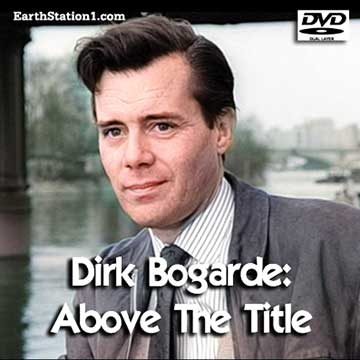
March 28, 1921: #BOTD: #HBD! Dirk
Bogarde, English matinee idol, actor, screenwriter and author (d.
May 8, 1999) is #born Derek Jules Gaspard Ulric Niven van den
Bogaerde in West Hampstead, London, England to Ulric van den
Bogaerde (1892-1972) and Margaret Niven (1898-1980). Ulric was
born in Perry Barr, Birmingham, of Flemish ancestry, and was art
editor of The Times. Initially a matinee idol in films such as
Doctor in the House (1954) for the Rank Organisation, Sir Dirk
Bogarde later acted in art-house films. Bogarde came to prominence
in films including The Blue Lamp in the early 1950s, before
starring in the successful Doctor film series (1954-63). He twice
won the BAFTA Award for Best Actor in a Leading Role; for The
Servant (1963) and Darling (1965). His other notable film roles
included Victim (1961), Accident (1967), The Damned (1969), Death
in Venice (1971), The Night Porter (1974), A Bridge Too Far (1977)
and Despair (1978). He was appointed a Commander of the Order of
Arts and Letters in 1990 and a Knight Bachelor in 1992. In a
second career, he wrote seven best-selling volumes of memoirs, six
novels and a volume of collected journalism, mainly from articles
in The Daily Telegraph. During five years of active military duty
during World War Two, he reached the rank of major and was awarded
seven medals. His poetry has been published in war anthologies; a
painting by Bogarde, also from the war, hangs in the British
Museum, with many more in the Imperial War Museum. Bogarde served
as an intelligence officer with Field Marshal Bernard Montgomery's
21st Army Group as it liberated Europe. Taylor Downing's book,
Spies in the Sky, tells of Bogarde's work in photo-reconnaissance
in the aftermath of D-Day, moving through Normandy with Royal
Canadian Air Force units. By July 1944, they were located at the
"B.8" airfield at Sommervieu, near Bayeux. As an air
photographic interpreter with the rank of captain, Bogarde was
later attached to the Second Army, where he selected ground
targets in France, Holland and Germany for the Second Tactical Air
Force and RAF Bomber Command. Villages on key routes were heavily
bombed to prevent the Wehrmacht's armour from reaching the
invasion lodgement areas. In a 1986 Yorkshire Television interview
with Russell Harty, Bogarde recalled going on painting trips,
sometimes to see the villages which he had selected as targets: "I
found what I had thought in the rubble were a whole row of
footballs, and they weren't footballs... they were children's
heads...A whole school of kids, a convent, had been pulled out of
school, and lined up in this little narrow alleyway between the
buildings to save them from the bombing, and the whole thing had
come in on top of them." Bogarde identified himself as one of
the first Allied officers to reach the Bergen-Belsen concentration
camp in Germany on April 20, 1945, an experience that had the most
profound effect on him and about which he had difficulty speaking
for many years afterward. In his 1986 Yorkshire Television
interview with Russell Harty, he said "The gates were opened,
and then I realised that I was looking at Dante's Inferno. And a
girl came up who spoke English, because she recognised one of the
badges, and she ... her breasts were like, sort of, empty purses,
she had no top on, and a pair of man's pyjamas, you know, the
prison pyjamas, and no hair... and all around us there were
mountains of dead people, I mean mountains of them, and they were
slushy, and they were slimy." The horror and revulsion at the
cruelty and inhumanity that he said he witnessed left him with a
deep-seated hostility towards Germany; in the late 1980s, he wrote
that he would disembark from a lift rather than ride with a German
of his generation. Nevertheless, three of his more memorable film
roles were as Germans, one of them as a former SS officer in The
Night Porter (1974). Bogarde was most vocal towards the end of his
life on voluntary euthanasia, of which he became a staunch
proponent after witnessing the protracted death of his lifelong
partner and manager Anthony Forwood (the former husband of actress
Glynis Johns) in 1988. He gave an interview to John Hofsess,
London executive director of the Voluntary Euthanasia Society: "My
views were formulated as a 24-year-old officer in Normandy ... On
one occasion, the jeep ahead hit a mine ... Next thing I knew,
there was this chap in the long grass beside me. A gurgling voice
said, "Help. Kill me." With shaking hands I reached for
my small pouch to load my revolver ... I had to look for my
bullets - by which time somebody else had already taken care of
him. I heard the shot. I still remember that gurgling sound. A
voice pleading for death." For nearly four decades, Bogarde
shared his homes, first in Amersham, Buckinghamshire, and then in
France, with Anthony Forwood, who had been married to actress
Glynis Johns during the 1940s. They were together until Forwood's
death in 1988. Bogarde repeatedly denied that his relationship to
Forwood was anything other than platonic. There was much
speculation as to whether this was in fact the case, given that
male homosexual acts were criminal during most of his career, and
could lead to prosecution and imprisonment. Rank Studio contracts
included morality clauses, which provided for termination in the
event of "immoral conduct" on the part of the actor.
These included same-sex relationships, thus potentially putting
the actor's career in jeopardy. Bogarde's refusal to enter into a
marriage of convenience was possibly a major reason for his
failure to become a star in Hollywood, together with the critical
and commercial failure of Song Without End. His friend Helena
Bonham Carter believed he did not come out during later life
because this would have unbearably highlighted his regret at
having been forced to camouflage his sexual orientation during his
film career. He struggled with the trauma of his active service,
compounded by rapid fame, recounting, "First there was the
war, and then the peace to cope with, and then suddenly I was a
film star. It happened all too soon." Dirk Bogarde died of a
heart attack at his home in London, England, aged 78. His ashes
were scattered at his former estate in Grasse, southern France. On
Sale @ 15% Off Discount Till Midnight PT!
https://store.earthstation1.com/dirk-bogarde-above-the-title-documentary-and-bonuses-mp4-download-dvd.html
Today's
EarthStation1.com 15% Off Commemorative Memorial Title: War Props:
The Ilyushin IL-2 Sturmovik DVD, MP4, USB Flash Drive
Today, March 28, 2026
March 28, 1913: #BOTD: #HBD! Nelson
Stepanyan, Il-2 pilot and regimental commander in the Soviet Air
Force who was twice awarded with the title of the Hero Of The
Soviet Union (d. December 14, 1944) is #born Nelson Georgievich
Stepanyan into an Armenian family in Shusha (Shushi), Elisabethpol
Governorate (modern Azerbaijan), where his father Gevorg ran the
Shusha office of the Singer sewing company. Soon after Nelson was
born, the Stepanyan family moved back to Yerevan. There Nelson
attended the Transcaucasian Preparatory Military School,
graduating from in 1930. He continued his studies at the Bataysk
Military Aviation School, where he graduated in 1935 and became a
flight instructor at the school from then until 1938. Stepanyan
was teaching at another military flight academy when Germany
invaded the Soviet Union in June 1941. He volunteered for combat
and participated in a number of battles as a pilot of an Ilyushin
Il-2 fighter bomber. Stepanyan took part in defensive battles at
Poltava, Zaporozhye, Odessa, Kakhovka, and Mykolaiv. During his
20th departure Stepanyan was wounded by shrapnel flak. He defended
the skies over Leningrad while he as a pilot in the 2nd Aviation
Squadron, part of the 57th Regiment in the Baltic Fleet's 8th
Aviation Brigade. As of November 1942, Stepanyan was reported to
have destroyed 78 German trucks, 67 tanks, 63 anti-aircraft guns,
nineteen mortars, 36 railroad cars, twenty merchantmen and
warships (including a destroyer), thirteen fuel tankers, twelve
armored cars, seven long-range guns, five ammunition dumps, and
five bridges. On October 23, 1942, the Supreme Soviet Of The
Soviet Union conferred upon Stepanyan the title of Hero of the
Soviet Union for the first time. Nelson Stepanyan died when his
squadron was attacked by German fighters during a sortie against
German naval targets in the ice-free Baltic Sea port of the state
city of Liepaja in western Latvia. His plane was hit by
anti-aircraft fire, and though wounded, he dove his plane into a
fleet of German ships. He died along with navigator of the 47th
Regiment, Captain Aleksandr Rumiantsev. Stepanyan's loss
devastated the rest of the men in the squadron. His fellow pilots
sent the following letter to his parents after his death:
"[Stepanyan was a] simple and modest man, close and beloved
by all; he was a father and teacher to all of us, a friend and a
commander.... We all wept when Nelson Gevorgovich failed to return
on that fateful day. They say that tears bring comfort. But the
few tears of a soldier, like the red-hot drops of metal, burn the
heart and call for vengeance." He was awarded the Hero of the
Soviet Union title a second time posthumously for his sacrifice.
Soviet sources assert that Stepanyan undertook in the course of
his life no less than 239 combat sorties, sunk 53 ships of which
thirteen he did alone, destroyed 80 tanks, 600 armored vehicles,
and 27 aircraft. On Sale @ 15% Off Discount Till Midnight PT!
https://store.earthstation1.com/war-props-the-ilyushin-il2-sturmovik-dvd-mp4-usb-flash-dri24.html
Today's
EarthStation1.com 15% Off Commemorative Memorial Title: Winston
Churchill: The Valiant Years TV Series DVD, MP4, USB Drive
Today, March 28, 2026
March 28, 1941: The European Civil War:
World War II: The Second European War (The European Theater Of
World War II): The Mediterranean And Middle East Theater Of World
War II: The Battle Of The Mediterranean: The Battle Of Cape
Matapan (Greek: Navmachia Tou Tainarou): The Battle Of Gaudo: --
The first day of the three-day battle occurs when Britain's
Mediterranean Fleet, comprised of the navies of the United Kingdom
and Australia, sinks a cruiser division of three heavy cruisers
and two destroyers of Italy's Regia Marina in what is known in
Italy as The Battle of Gaudo. Squadron-Vice-Admiral Angelo Iachino
who commanded the Italian squadron later wrote that the battle had
"the consequence of limiting for some time our operational
activities, not for the serious moral effect of the losses, as the
British believed, but because the operation revealed our
inferiority in effective aero-naval cooperation and the
backwardness of our night battle technology." The Battle Of
Cape Matapan was fought from March 27-29, 1941 off the
south-western coast of the Peloponnesian Peninsula of Greece after
the interception and decryption of Italian signals by the
Government Code and Cypher School (G C & C S) at Bletchley
Park (the decrypted intelligence codenamed Ultra). Ships of the
Royal Navy and Royal Australian Navy, under the command of Royal
Navy Admiral Sir Andrew Cunningham, intercepted and sank or
severely damaged several ships of the Italian Regia Marina under
Iachino. On Sale @ 15% Off Discount Till Midnight PT!
https://store.earthstation1.com/winston-churchill-the-valiant-years-dvd-set-all-26-shows-7-d267.html
Today's
EarthStation1.com 15% Off Commemorative Memorial Title: Crusade In
Europe WWII TV Series DVD, Video Download, USB Flash Drive
Today, March 28, 2026
March 28, 1942: The European Civil War:
World War II: The Second European War (The European Theater Of
World War II): The North West Europe Campaign Of World War II: The
St Nazaire Raid (Operation Chariot): -- In what became known as
"The Greatest Raid Of All" within the British military,
a Combined Operations Headquarters amphibious attack force, troops
of the department of the British War Office set up to harass the
Germans on the European continent with raids by combined naval and
army forces. permanently disables the Louis Joubert Lock, also
known as the Normandie Dock, in Saint-Nazaire in order to keep the
German battleship Tirpitz away from the mid-ocean convoy lanes.
The St Nazaire Raid or Operation Chariot was undertaken by the
Royal Navy and British Commandos under the auspices of Combined
Operations Headquarters. St Nazaire was targeted because the loss
of its dry dock would force any large German warship in need of
repairs, such as the Bismarck's sister ship Tirpitz, to return to
home waters via either the English Channel or the GIUK gap, both
of which were heavily defended by British units including the
Royal Navy's Home Fleet, rather than having a haven available on
the Atlantic coast in Nazi-occupied France. The obsolete destroyer
HMS Campbeltown, a Town-class destroyer transferred from the
United States Navy to the Royal Navy in exchange for military
bases under the Destroyers for Bases Agreement, accompanied by 18
smaller craft, crossed the English Channel to the Atlantic coast
of France and was rammed into the Normandie dock gates. The ship
had been packed with delayed-action explosives, well hidden within
a steel and concrete case, that detonated later that day, putting
the dock out of service for the remainder of the war and up to
five years after. A force of commandos landed to destroy machinery
and other structures. Heavy German gunfire sank, set ablaze, or
immobilised virtually all the small craft intended to transport
the commandos back to England; the commandos had to fight their
way out through the town to try to escape overland. Almost all
were forced to surrender when their ammunition was expended and
they were surrounded and captured by the Wehrmacht defending
Saint-Nazaire. After the raid, 228 men of the force of 611
returned to Britain; 169 were killed and 215 became prisoners of
war. German casualties were over 360 dead, some killed after the
raid when Campbeltown exploded. To recognise their bravery, 89
decorations were awarded to members of the raiding party,
including five Victoria Crosses. After the war, St Nazaire was one
of 38 battle honours awarded to the Commandos. On Sale @ 15% Off
Discount Till Midnight PT!
https://store.earthstation1.com/crusade-in-europe-2-dual-layer-dvds-tv-series-eisenhowe2.html
Today's
EarthStation1.com 15% Off Commemorative Memorial Title:
Kristallnacht: 1938 Jewish Pogrom Documentaries MP4 Video Download
DVD
Today, March 28, 2026
March 28, 1921: #BOTD: Herschel
Grynszpan, a Polish-Jewish refugee born in Germany and assassin of
Ernst vom Rath, a diplomat at the German embassy in Paris (last
rumoured to be alive 1945, declared dead 1960), is #born Herschel
Feibel Grunszpan in Hanover, Germany. He was a Polish-Jewish
refugee, born in Germany. His assassination of the German diplomat
Ernst vom Rath on November 7, 1938 in Paris was used by the Nazis
as a pretext to launch Kristallnacht, the antisemitic pogrom of
9-10 November 1938. Grynszpan was seized by the Gestapo after the
Fall of France and brought to Germany. Grynszpan's eventual fate
remains unknown. It was assumed that he probably did not survive
the Second World War, and he was declared dead in 1960. In 2016 a
photograph of a man resembling Grunszpan was cited as evidence to
support the claim that he was still alive in Bamberg, Germany, as
of July 3, 1946. He is the subject of the book "The Short,
Strange Life of Herschel Grynszpan", by author Jonathan
Kirsch. On Sale @ 15% Off Discount Till Midnight PT!
https://store.earthstation1.com/more-than-broken-glass-memories-of-kristallnacht-dvd.html
Today's
EarthStation1.com 15% Off Commemorative Memorial Title: Nikita
Khrushchev Documentaries Collection DVD, Download, USB Drive
Today, March 28, 2026
March 28, 1893: #BOTD: #HBD! Spyros
Skouras, Greek-American businessman, shipping magnate, motion
picture pioneer and film executive who was the president of the
20th Century-Fox from 1942 to 1962 and famously had a friendly
confrontation with Nikita Khrushchev at a studio luncheon (d.
August 16, 1971) is #born Spyros Panagiotis Skouras in
Skourochori, Greece. He resigned the presidency of 20th Century
Fox on June 27, 1962, but served as chairman of the company for
several years. He also had numerous ships, owning Prudential
Lines. Skouras and two brothers came to the United States as
immigrants in 1910; Spyros kept such a pronounced Greek accent in
English that comedian Bob Hope would joke "Spyros has been
here twenty years but he still sounds as if he's coming next
week." Skouras oversaw the production of such epics as
Cleopatra (1963) with Elizabeth Taylor, as well as the development
of Century City. His grandchildren include Charles P. Skouras III,
a film and television executive. His great-granddaughter Marielle
Skouras has produced more than 25 television shows and created
Beverly Hills Pawn, a hit reality show on REELZchannel. On Sale @
15% Off Discount Till Midnight PT!
https://store.earthstation1.com/nikita-khrushchev-documentaries-dvd.html
Today's
EarthStation1.com 15% Off Commemorative Memorial Title: The Story
Of Civilization: Will & Ariel Durant DVD, MP3 Download, USB
Today, March 28, 2026
March 28, AD 37: Rome: Ancient Rome: The
Roman Empire: -- Roman emperor Caligula accepts the titles of the
Principate, entitled to him by the Senate. The Principate is the
name sometimes given to the first period of the Roman Empire from
the beginning of the reign of Augustus in 27 BC to the end of the
Crisis of the Third Century in 284 AD, after which it evolved into
the so-called Dominate. The Principate is characterised by the
reign of a single emperor (princeps) and an effort on the part of
the early emperors, at least, to preserve the illusion of the
formal continuance, in some aspects, of the Roman Republic.
Although he was born Gaius Julius Caesar Augustus Germanicus (31
August AD 12 - 24 January AD 41), Gaius Caesar for short , he
acquired the nickname "Caligula" (meaning "little
soldier's boot", the diminutive form of caliga) from his
father's soldiers during their campaign in Germania. He was Roman
emperor from AD 37 to AD 41. The son of Germanicus, a popular
Roman general, and Agrippina the Elder, the granddaughter of
Augustus, Caligula was born into the first ruling family of the
Roman Empire, conventionally known as the Julio-Claudian dynasty.
Two years after Caligula's birth, Germanicus' uncle and adoptive
father, Tiberius, succeeded Augustus as emperor of Rome in AD 14.
When his father Germanicus died at Antioch in AD 19 under
suspicious circumstances that, according to author Robert Graves,
implicated Caligula, Agrippina returned with her six children to
Rome, where she became entangled in a bitter feud with Tiberius.
The conflict eventually led to the destruction of her family, with
Caligula as the sole male survivor. Untouched by the deadly
intrigues, Caligula accepted an invitation in AD 31 to join the
emperor on the island of Capri, where Tiberius had withdrawn five
years earlier. Following the death of Tiberius, Caligula succeeded
his adoptive grandfather as emperor in AD 37. In early AD 41,
Caligula was assassinated as a result of a conspiracy by officers
of the Praetorian Guard, senators, and courtiers. The
conspirators' attempt to use the opportunity to restore the Roman
Republic was thwarted, however. On the day of the assassination of
Caligula, the Praetorians declared Caligula's crippled uncle,
Claudius, the next Roman emperor. Although the Julio-Claudian
dynasty continued to rule the empire until the fall of Nero in AD
68, Caligula's death marked the official end of the Julii Caesares
in the male line. On Sale @ 15% Off Discount Till Midnight PT!
https://store.earthstation1.com/story-of-civilization-will-amp-ariel-durant-mp3-dvd-11-audiobo311.html
Today's
EarthStation1.com 15% Off Commemorative Memorial Title: The World:
A Television History Documentary Series DVD, Download, USB
Today, March 28, 2026
March 28, 1871: The Unification Of
Germany (German: Deutsche Einigung): The Franco-Prussian War (The
Franco-German War, The War Of 1870): The Siege Of Paris (The Siege
Of Paris 1870-1871): The Paris Commune (March 18 - May 28, 1871:
-- The Paris Commune is formally established in Paris. The Paris
Commune was a radical socialist and revolutionary government that
ruled Paris from March 28 to May 28, 1871. Following the defeat of
Emperor Napoleon III in September 1870, the Second French Empire
swiftly collapsed. In its stead rose a Third Republic at war with
Prussia, which laid siege to Paris for four months. A hotbed of
working-class radicalism, France's capital was primarily defended
during this time by the often politicized and radical troops of
the National Guard rather than regular Army troops. In February
1871 Adolphe Thiers, the new chief executive of the French
national government, signed an armistice with Prussia that
disarmed the Army but not the National Guard. Soldiers of the
Commune's National Guard killed two French army generals, and the
Commune refused to accept the authority of the French government.
The regular French Army suppressed the Commune during "La
Semaine Sanglante" ("The Bloody Week") beginning on
May 21, 1871. Debates over the policies and outcome of the Commune
had significant influence on the ideas of Karl Marx, who described
it as an example of the "dictatorship of the proletariat".
On Sale @ 15% Off Discount Till Midnight PT!
https://store.earthstation1.com/the-world-a-television-history-4-dual-layer-dvds-all-26-sh426.html
Today's
EarthStation1.com 15% Off Commemorative Memorial Title: Frieda:
David Farrar Glynis Johns Mai Zetterling Flora Robson MP4 DVD
Today, March 28, 2026
March 28, 1902: #BOTD: #HBD! Dame Flora
McKenzie Robson (Flora Robson), English actress and star of the
theatrical stage and cinema, particularly renowned for her
performances in plays demanding dramatic and emotional intensity
(d. July 7, 1984) is #born Flora McKenzie Robson in South Shields,
a coastal town in South Tyneside, County Durham (now Tyne and Wear
Metropolitan County) in North East England of Scottish descent.
Her acting range extended from queens to murderesses. She was
educated at the Palmers Green High School and the Royal Academy of
Dramatic Art, where she won a bronze medal in 1921. Her father
discovered that Flora had a talent for recitation and, from the
age of 5, she was taken around by horse and carriage to recite,
and to compete in recitations. This established a pattern that
remained with her. Robson made her stage debut in 1921. By the
1930s she was appearing in several prominent films both in the UK
and in Hollywood, alongside such stars as Laurence Olivier, Paul
Muni and George Raft. Her most notable role was that of Queen
Elizabeth I in both Fire Over England (1937) and The Sea Hawk
(1940). In 1934, Robson played the Empress Elizabeth in Alexander
Korda's The Rise of Catherine the Great (1934). She was nominated
for the Academy Award for Best Supporting Actress for her role as
Angelique Buiton, a servant, in Saratoga Trunk (1945). The same
year, audiences in the U.K. and the U.S. watched her hypnotic
performance as Ftatateeta, the nursemaid and royal confidante and
murderess-upon-command to Vivien Leigh's Queen Cleopatra in the
screen adaptation of George Bernard Shaw's Caesar and Cleopatra
(1945). After the Second World War, demonstrating her range, she
appeared in Holiday Camp (1947), the first of a series of films
which featured the very ordinary Huggett family; as Sister
Philippa in Black Narcissus (1947); as a magistrate in Good-Time
Girl (1948); as a prospective Labour MP in Frieda (1947); and in
the costume melodrama Saraband for Dead Lovers (1948). Her other
film roles included the Empress Dowager Cixi in 55 Days at Peking
(1963), Miss Milchrest in Murder at the Gallop (1963), the Queen
of Hearts in Alice's Adventures In Wonderland (1972), and Livia in
the aborted I, Claudius in 1937. She struggled to find a footing
in the theatre after she graduated from RADA with a bronze medal
since she lacked the conventional good looks which were then an
absolute requisite for actresses in dramatic roles. After touring
in minor parts with Ben Greet's Shakespeare company she may have
played small parts for two seasons in the new repertory company at
Oxford, but her contract was not renewed. She was told that they
required a prettier actress. Unable to secure any acting
engagements, she gave up the stage at the age of 23, and she took
up work as a welfare officer in the Shredded Wheat factory in
Welwyn Garden City. Tyrone Guthrie, due to direct a season at the
new Festival Theatre, Cambridge, asked her to join his company.
Her performance as the stepdaughter in Pirandello's Six Characters
in Search of an Author made her the theatrical talk of Cambridge.
She followed with Isabella in Measure for Measure with Robert
Donat, Pirandello's Naked, the title role in Iphigenia in Tauris,
Varya in The Cherry Orchard, and Rebecca West in Henrik Ibsen's
Rosmersholm. In 1931, she was cast as the adulterous Abbie in
Eugene O'Neill's Desire Under the Elms. Her brief, shocking
appearance as the doomed prostitute in James Bridie's play The
Anatomist put her firmly on the road to success. "If you are
not moved by this girl's performance, then you are immovable"
the Observer critic wrote. This success would lead to her famous
1933 season as leading lady at the Old Vic. She continued her
acting career late into life, though not on the West End stage,
from which she retired at the age of 67, often for American
television films, including a lavish production of A Tale of Two
Cities (in which she played Miss Pross). She also performed for
British television, including The Shrimp and the Anemone. In the
1960s, she continued to act in the West End, in Ring Round the
Moon, The Importance of Being Earnest and Three Sisters, among
others. She continued to act on film and television. She was last
briefly seen as a Stygian Witch in the fantasy adventure Clash of
the Titans in 1981. Both the BBC and ITV made special programs to
celebrate her 80th birthday in 1982, and the BBC ran a short
season of her best films. She was nominated for an Academy Award
for Best Supporting Actress as Angelique Buiton, a Haitian maid,
in Saratoga Trunk (1945). She was created a Commander of the Order
of the British Empire (CBE) in the 1952 New Year Honours, and
raised to Dame Commander (DBE) in the 1960 Birthday Honours. She
was also the first famous name to become president of the Brighton
Little Theatre. On July 4, 1958, she received an honorary DLitt
from Durham University at a congregation in Durham Castle. She was
the subject of This Is Your Life in February 1961 when she was
surprised by Eamonn Andrews in central London. Her private life
was largely focused on her large family of sisters, nephews and
nieces, who used the home in Wykeham Terrace, Brighton, which she
shared with sisters, Margaret and Shela. She died in Brighton,
aged 82, in her sleep, of cancer. She was never married and had no
children. The two sisters, with whom she shared her life and home,
died around the same time: Shela shortly before Flora, in 1984,
and Margaret on 1 February 1985. Dame Flora Robson Avenue, built
in 1962, in Simonside, South Shields, is named after her. There is
a plaque on the house in Wykeham Terrace, Dyke Road, Brighton, and
also one in the doorway of St. Nicholas's Church, of which Flora
Robson was a great supporter. There is also a plaque to
commemorate the opening of the Prince Charles Theatre (Leicester
Square, London) by Flora Robson. In 1996, the British Film
Institute erected a plaque at number 14 Marine Gardens, location
of Flora's other home in Brighton, where she lived from 1961 to
1976. A plaque at 40 Handside Lane in Welwyn Garden City records
Flora Robson living there from 1923 to 1925. A blue plaque
sponsored by Southgate District Civic Trust and Robson's former
school Palmers Green High School was unveiled at her family home
from 1910 to 1921, The Lawe, 65, The Mall, Southgate, on April 25,
2010. Robson attended the opening of the Flora Robson Playhouse in
Jesmond, Newcastle upon Tyne, in 1962, which was named in her
honour. The building was demolished in 1971 and the theatre
company it housed relocated to the new University Theatre. On Sale
@ 15% Off Discount Till Midnight PT!
https://store.earthstation1.com/frieda-dvd-post-wwii-drama-flora-robson-mai-zetterling.html
Today's
EarthStation1.com #OnThisDay Commemorative Memorial Title: Teenage
Dating Films 1946-1958 DVD, MP4 Video Download, USB Drive
Today, March 28, 2026 March 28: National Something On A Stick
Day: -- There seems to be no specific historical event attached to
the beginning of the day's observance nationally; it is more
likely a case of a fun-loving individual or group of people
manipulating internet search results via the wizardry of SEO to
boost the holiday's legitimacy, and we don't mind! There's no
getting around it, food on a stick is fun. Well, maybe we wouldn't
try to eat Jeff Dunham's 'Jalapeno on a Stick,' but as far as
candy apples, creamsicles, shish kabobs, and teriyaki chicken on a
stick are concerned, today is the day to chow down! The use of
sticks - skewers of wood - in the preparation and consumption of
food items goes back a long way. A very long way. An archeological
site in Germany contained a stick with a burnt tip, indicating its
use in the cooking of meat over a fire, from 300,000 years ago,
the Lower Paleolithic era. From ancient Greece, Homer's "Iliad"
makes mention of cooking meat on skewers. In the absence of a
metal grill to set over a wood fire, piercing your meat with a
sharpened stick and holding it over the flames to cook while you
turn it and adjust its height above the flames for ideal doneness
is a no-brainer. Perhaps this is the sole reason that this method
has been around for millennia. There's even a story, popular among
medieval scholars, of Turkish soldiers in the crusades using their
swords as spits to cook meat with. Make that thing a multitasker!
So the next time you are out camping and you cook your hot dog at
the end of a sapling branch you've found, know that you're in good
company - humans have cooked meat that way for almost as long as
there have been humans. And National Something On A Stick Day is
the perfect time to reflect on that.
https://store.earthstation1.com/teenage-dating-films-194619461958.html
March 28: National Something On A Stick
Day: -- There seems to be no specific historical event attached to
the beginning of the day's observance nationally; it is more
likely a case of a fun-loving individual or group of people
manipulating internet search results via the wizardry of SEO to
boost the holiday's legitimacy, and we don't mind! There's no
getting around it, food on a stick is fun. Well, maybe we wouldn't
try to eat Jeff Dunham's 'Jalapeno on a Stick,' but as far as
candy apples, creamsicles, shish kabobs, and teriyaki chicken on a
stick are concerned, today is the day to chow down! The use of
sticks - skewers of wood - in the preparation and consumption of
food items goes back a long way. A very long way. An archeological
site in Germany contained a stick with a burnt tip, indicating its
use in the cooking of meat over a fire, from 300,000 years ago,
the Lower Paleolithic era. From ancient Greece, Homer's "Iliad"
makes mention of cooking meat on skewers. In the absence of a
metal grill to set over a wood fire, piercing your meat with a
sharpened stick and holding it over the flames to cook while you
turn it and adjust its height above the flames for ideal doneness
is a no-brainer. Perhaps this is the sole reason that this method
has been around for millennia. There's even a story, popular among
medieval scholars, of Turkish soldiers in the crusades using their
swords as spits to cook meat with. Make that thing a multitasker!
So the next time you are out camping and you cook your hot dog at
the end of a sapling branch you've found, know that you're in good
company - humans have cooked meat that way for almost as long as
there have been humans. And National Something On A Stick Day is
the perfect time to reflect on that.
https://store.earthstation1.com/teenage-dating-films-194619461958.html
Today's
EarthStation1.com #OnThisDay Commemorative Memorial Title: TV
Commercials: The Cable Age Classics II DVD, Download, USB Drive
Today, March 28, 2026March 28: National Hot Tub Day: -- The
best day to love your hot tub! Want to feel the soothing effects
your hot tub has for a long time without feeling judged? National
Hot Tub Day allows you to do so. Even though it's not an official
holiday, National Hot Tub Day is a good opportunity to savor the
benefits of a spa. With a hot tub, you can spend more time with
your loved ones. As the jets relieve your tense muscles, you may
relax and converse with your companion. Enjoy a mini-vacation in
your backyard today in your hot tub. Early Egyptians may have
taken hot therapeutic baths some 4,000 years ago, according to
archaeological evidence. In 600 B.C., King Phraortes of ancient
Persia had a hot tub chiseled out of solid granite for him. Plato,
Homer, and Hippocrates, three of Greece's greatest thinkers, all
believed in the medicinal properties of hot water. Water springs
drew people together for social gatherings and other activities in
the form of elaborate constructions. And then there was Rome. The
imperial leaders there were even more extravagant than those who
came before them and built massive spas to match. Many of these
facilities were built to aid the recuperation of exhausted
legionnaires who had suffered wartime injuries and illnesses. The
name 'Sanus Per Aquam,' which means 'health through water,' is the
origin of the acronym for the term spa. Sports stadiums, spas,
massage parlors, and eateries were common features of Roman spas.
California is considered to have been the birthplace of the first
modern home spas, starting in 1958, which were commonly
constructed out of old redwood vats and disused wine barrels. When
it came to hot tubs, water cleanliness and filtration systems
weren't exactly high on the list of priorities during the swinging
sixties. As a result, wood was used as a building component that
failed to keep water out and was a breeding ground for
disease-causing germs, mildew, algae, and slime. In the late
1970s, fiberglass shell hot tubs were introduced, which quickly
replaced cast acrylic tubs. For owners, this made maintaining
water cleanliness a lot easier, while manufacturers could start
developing pumps, filters, control systems, and jets out of the
pliable and adaptable plastic. It wasn't until an Italian
migrant's labor that hot tub design took a turn for the better.
Candido Jacuzzi, an aircraft engineer, developed a whirlpool bath
for his son Ken, who was suffering from rheumatoid arthritis a few
decades before. Jacuzzi became synonymous with hot tubs after a
third-generation family member, Roy Jacuzzi, created and
commercialized the first self-contained and completely integrated
whirlpool spa.
https://store.earthstation1.com/tv-commercials-the-cable-age-classics-ii-dvd.html
Today's
EarthStation1.com #OnThisDay Commemorative Memorial Title:
Decades: The 1960s TV Series DVD, Video Download, USB Flash Drive
Today, March 28, 2026March 28, 1914: #BOTD: #HBD! Edmund S.
Muskie Day: -- Edmund Muskie, American lieutenant, lawyer,
politician and statesman, 58th United States Secretary Of State
under President Jimmy Carter, a United States Senator from Maine
from 1959 to 1980, the 64th Governor of Maine from 1955 to 1959, a
member of the Maine House of Representatives from 1946 to 1951,
and the Democratic Party's candidate for Vice President of the
United States in the 1968 election (d. March 26, 1996) is #born
Edmund Sixtus Muskie in Rumford, Maine to Polish parents. Muskie
graduated from Bates College in Lewiston, and Cornell University
in Ithaca. He worked as a lawyer for two years before serving in
the United States Naval Reserve from 1942 to 1945 during World War
II. Upon his return, Muskie served in the Maine State Legislature
from 1946 to 1951 against heavy Republican opposition. Despite an
unsuccessful bid for the mayoralty of Waterville, he was elected
the 64th Governor of Maine in an upset victory as its first Roman
Catholic in 1954. Although elected as a reform Governor, Muskie
split from his mandate; he amended its constitution multiple times
to consolidate power, suspended the "as Maine goes, so goes
the nation" doctrine, pressed aggressive economic
expansionism and instated strict environmental provisions.
Muskie's actions severed a nearly 100-year Republican stronghold
and led to the political insurgency of the Maine Democrats. He
used his increased public presence to gain a seat in the United
States Senate representing his home state. His legislative
accomplishments during his career as a Senator facilitated a vast
expansion of modern liberalism in the United States. He fathered
the 1960s environmental movement which culminated in the passage
of the Clean Air Act of 1970 and Clean Water Act of 1972,
hallmarks of international environmental policy. A supporter of
the civil rights movement, Muskie rallied support for the Civil
Rights Act Of 1964, the creation of Martin Luther King Jr. Day and
tapered Richard Nixon's "Imperial Presidency" by
advancing New Federalism. Muskie ran alongside Hubert Humphrey
against Nixon in the 1968 presidential election, only to lose by
0.7 percentage points (42.72% vs. 43.42%), one of the narrowest
margins in the history of the United States. He would go on to run
in the 1972 presidential election where he secured 1.84 million
votes in the primaries coming in fourth out of 15 contesters. The
release of the controversial "Canuck letter" derailed
his campaign, a forged letter to the editor of the Manchester
Union Leader published February 24, 1972, two weeks before the New
Hampshire primary, which implied that Senator Muskie held
prejudice against Americans of French-Canadian descent. A day
later, the same paper released an article that contained
accusatory reference to his wife, Jane, as a drunkard and racially
intolerant. On the morning of February 26, Muskie gave a speech to
supporters outside of the Manchester Union-Leader offices in
Manchester, New Hampshire. His speech was viewed as emotional and
defensive; he called the newspaper's editor a "gutless
coward". Muskie gave the speech during a snowstorm which
created the appearance of him crying. Though Muskie later
attempted to claim that what had appeared to the press as tears
were actually melted snowflakes, the press reported that Muskie
broke down and cried, shattering the candidate's image as calm and
reasoned. Evidence later came to light during the Watergate
scandal investigation that, during the 1972 presidential campaign,
the Nixon campaign committee maintained a "dirty tricks"
unit focused on discrediting Nixon's strongest challengers.
Federal Bureau of Investigation (FBI) investigators revealed that
the Canuck Letter was a forged document as part of the
dirty-tricks campaign against Democrats orchestrated by the Nixon
campaign. Nixon was also reported to have ordered men to follow
Muskie around and gather information. He tried to connect Muskie's
acquaintance with singer Frank Sinatra to an abuse of office.
Muskie often flew on Sinatra's private plane while traveling
around California. After the election, he returned to the Senate
where he gave the 1976 State of the Union Response. Muskie served
as first chairman of the new Senate Budget Committee from 1975 to
1980 where he established the United States budget process. Upon
his retirement from the Senate, Carter nominated him to serve as
the 58th U.S. Secretary Of State; he was confirmed to take office
by a margin of 94-2. Assuming the office in the middle of a series
of violent international conflicts, his biggest success as
secretary came when his state department negotiated the release of
52 Americans concluding the Iran hostage crisis. He was awarded
the Presidential Medal Of Freedom in 1981 and is honored with a
public holiday in Maine. Edmund Muskie died at 4:06 AM EST in the
morning at the Georgetown University Medical Center in Washington,
D.C. two days shy of his 82nd birthday after seeking treatment for
bouts of congestive heart failure. Eight days prior he underwent a
carotid endarterectomy in his right neck. His assistant reported
that he had suffered a myocardial infarction. Some historians
believe that his blood clots were brought on from frequent 8,421
mile (13,552 km) flights to Cambodia; he was asked to assist in
stabilizing its government on behalf of President Bill Clinton.
Due to his service in the United States Naval Reserve during World
War II, he was eligible to be buried at Arlington National
Cemetery in Arlington County, Virginia. His ultimate rank of
lieutenant had him placed in Section 25 of the cemetery. Although
he died on March 26, his grave stone initially noted that he died
on the 25th. His wife, Jane, died on December 25, 2004, at age 77,
due to health complications brought on by Alzheimer's disease. She
was buried next to Muskie and his grave stone was corrected to
read "March 26, 1996". Muskie was memorialized in
Washington D.C., Lewiston, Maine, and Bethesda, Maryland. At his
Washington memorial, he was paid tribute to by a variety of U.S.
senators and house representatives. His alma mater, Bates College,
held a memorial presided over by its president, Donald Harward. On
March 30, 1996, a publicly broadcast, Roman Catholic funeral was
held in Bethesda at the Church of the Little Flower. He was
eulogized by U.S. president Jimmy Carter; U.S. Senator, George J.
Mitchell; 20th United States Ambassador to the United Nations,
Madeleine Albright; a political aide, Leon G. Billings; and one of
Muskie's sons, Stephen.
https://store.earthstation1.com/decades-the-1960s-dvd-set-peter-jennings-tv-series-3-19603.html
Today's
EarthStation1.com #OnThisDay Commemorative Memorial Title: Dwight
D. Eisenhower: In War And Peace DVD, Video Download, USB Drive
Today, March 28, 2026March 28, 1969: #DOTD: #RIP: Dwight D.
Eisenhower GCB, OM, RE, GCS, CCLH, KC, NPk, popularly known as
"Ike", American general, politician and statesman who
served as the 34th president of the United States from 1953 to
1961 (b. October 14, 1890) #dies in the morning in Washington,
D.C., of congestive heart failure at Walter Reed Army Medical
Center, at age 78. The following day, his body was moved to the
Washington National Cathedral's Bethlehem Chapel, where he lay in
repose for 28 hours. He was then transported to the United States
Capitol, where he lay in state in the Capitol Rotunda on March 30
and 31. A state funeral service was conducted at the Washington
National Cathedral on March 31. The president and First Lady,
Richard and Pat Nixon, attended, as did former president Lyndon
Johnson. Also among the 2,000 invited guests were U.N. Secretary
General U Thant and 191 foreign delegates from 78 countries,
including 10 foreign heads of state and government. Notable guests
included President Charles de Gaulle of France, who was in the
United States for the first time since the state funeral of John
F. Kennedy, Chancellor Kurt-Georg Kiesinger of West Germany, King
Baudouin of Belgium and Shah Mohammad Reza Pahlavi of Iran. The
service included the singing of Faure's The Palms, and the playing
of the hymn Onward, Christian Soldiers. That evening, Eisenhower's
body was placed onto a special funeral train for its journey from
the nation's capital through seven states to his hometown of
Abilene, Kansas. First incorporated into President Abraham
Lincoln's funeral in 1865, a funeral train would not be part of a
U.S. state funeral again until 2018. Eisenhower is buried inside
the Place of Meditation, the chapel on the grounds of the
Eisenhower Presidential Center in Abilene. As requested, he was
buried in a Government Issue casket, wearing his World War II
uniform, decorated with Army Distinguished Service Medal with
three oak leaf clusters, Navy Distinguished Service Medal, and the
Legion of Merit. Buried alongside Eisenhower are his son Doud, who
died at age 3 in 1921, and wife Mamie, who died in 1979. President
Richard Nixon eulogized Eisenhower in 1969, saying: "Some men
are considered great because they lead great armies or they lead
powerful nations. For eight years now, Dwight Eisenhower has
neither commanded an army nor led a nation; and yet he remained
through his final days the world's most admired and respected man,
truly the first citizen of the world." Dwight D. Eisenhower
was born Dwight David Eisenhower in Denison, Texas. During World
War II, he served as Supreme Commander of the Allied Expeditionary
Force in Europe, and achieved the rare five-star rank of General
of the Army. He was responsible for planning and supervising the
invasion of North Africa in Operation Torch in 1942-1943 and the
successful invasion of Normandy in 1944-1945 from the Western
Front. Eisenhower was raised in Abilene, Kansas, in a large family
of mostly Pennsylvania Dutch ancestry. His family had a strong
religious background. His mother became a Jehovah's Witness.
Eisenhower, however, did not belong to any organized church until
1952. He graduated from West Point in 1915 and later married Mamie
Doud, with whom he had two sons. During World War I, he was denied
a request to serve in Europe and instead commanded a unit that
trained tank crews. Following the war, he served under various
generals and was promoted to the rank of brigadier general in
1941. After the United States entered World War II, Eisenhower
oversaw the invasions of North Africa and Sicily before
supervising the invasions of France and Germany. After the war, he
served as Army Chief of Staff (1945-1948), as president of
Columbia University (1948-1953) and as the first Supreme Commander
of NATO (1951-1952). In 1952, Eisenhower entered the presidential
race as a Republican to block the isolationist foreign policies of
Senator Robert A. Taft; Taft opposed NATO and wanted no foreign
entanglements. Eisenhower won that election and the 1956 election
in landslides, both times defeating Adlai Stevenson II.
Eisenhower's main goals in office were to contain the spread of
communism and reduce federal deficits. In 1953, he threatened to
use nuclear weapons until China agreed to peace terms in the
Korean War. China did agree and an armistice resulted which
remains in effect. His New Look policy of nuclear deterrence
prioritized inexpensive nuclear weapons while reducing funding for
expensive Army divisions. He continued Harry S. Truman's policy of
recognizing Taiwan as the legitimate government of China, and he
won congressional approval of the Formosa Resolution. His
administration provided major aid to help the French fight off
Vietnamese Communists in the First Indochina War. After the French
left, he gave strong financial support to the new state of South
Vietnam. He supported regime-changing military coups in Iran and
Guatemala orchestrated by his own administration. During the Suez
Crisis of 1956, he condemned the Israeli, British, and French
invasion of Egypt, and he forced them to withdraw. He also
condemned the Soviet invasion during the Hungarian Revolution Of
1956 but took no action. After the Soviet Union launched Sputnik
in 1957, Eisenhower authorized the establishment of NASA, which
led to the Space Race. He deployed 15,000 soldiers during the 1958
Lebanon crisis. Near the end of his term, he failed to set up a
summit meeting with the Soviets when a U.S. spy plane was shot
down over the Soviet Union. He approved the Bay Of Pigs invasion,
which was left to John F. Kennedy to carry out. On the domestic
front, Eisenhower was a moderate conservative who continued New
Deal agencies and expanded Social Security. He covertly opposed
Joseph McCarthy and contributed to the end of McCarthyism by
openly invoking executive privilege. He signed the Civil Rights
Act of 1957 and sent Army troops to enforce federal court orders
which integrated schools in Little Rock, Arkansas. His largest
program was the Interstate Highway System. He promoted the
establishment of strong science education via the National Defense
Education Act. His two terms saw unprecedented economic prosperity
except for a minor recession in 1958. In his farewell address to
the nation, he expressed his concerns about the dangers of massive
military spending, particularly deficit spending and government
contracts to private military manufacturers, which he dubbed "the
military-industrial complex". Historical evaluations of his
presidency place him among the upper tier of American presidents.
https://store.earthstation1.com/dwight-d-eisenhower-documentaries-dual-layer-dvd.html
Today's
EarthStation1.com #OnThisDay Commemorative Memorial Title: St.
Louis Blues 1958 Nat King Cole + Bonus W. C. Handy Tribute DVD MP4
Today, March 28, 2026March 28, 1958: #DOTD: #RIP: W. C. Handy,
African American trumpet player and composer known as the "Father
of the Blues" (b. November 16, 1873) #dies of bronchial
pneumonia at Sydenham Hospital in New York City, aged 84. Over
25,000 people attended his funeral in Harlem's Abyssinian Baptist
Church. Over 150,000 people gathered in the streets near the
church to pay their respects. He is buried in Woodlawn Cemetery in
the Bronx. W. C. Hand was born William Christopher Handy in
Florence, Alabama, the son of Elizabeth Brewer and Charles Barnard
Handy. His father was the pastor of a small church in
Guntersville, a small town in northeast central Alabama. Handy
wrote in his 1941 autobiography Father Of The Blues that he was
born in a log cabin built by his grandfather William Wise Handy,
who became an African Methodist Episcopal minister after the
Emancipation Proclamation. The log cabin of Handy's birth has been
preserved near downtown Florence. William Christopher Handy is one
of the most influential American songwriters. He was one of many
musicians who played the distinctively American blues music, and
he is credited with giving it its contemporary form. Handy did not
create the blues genre and was not the first to publish music in
the blues form, but he took the blues from a regional music style
(Delta blues) with a limited audience to one of the dominant
national forces in American music. Handy was an educated musician
who used elements of folk music in his compositions. He was
scrupulous in documenting the sources of his works, which
frequently combined stylistic influences from various performers.
https://store.earthstation1.com/st-louis-blues-1958-dvd-nat-king-cole-eartha-1958.html
Today's
EarthStation1.com #OnThisDay Commemorative Memorial Title: That
Rhythm, Those Blues + Bonus The Death Of R & B? MP4 Download
DVD
Today, March 28, 2026March 28, 1974: #DOTD: #RIP: Arthur
Crudup, also known as Big Boy Crudup, American Delta blues singer,
songwriter and guitarist, sometimes referred to as the "Father
Of Rock And Roll" (b. August 24, 1905) #dies of complications
of heart disease and diabetes aged 68 in the Nassawadox hospital
in Northampton County, Virginia, four years after a protracted and
failed battle for a settlement on unpaid and overdue royalties. He
is buried at Bethel Memorial Gardens cemetery in Franktown,
Virginia. Born Arthur William Crudup in Forest, Mississippi, to a
family of migrant workers, he is best known, outside blues
circles, for his songs "That's All Right" (1946), "My
Baby Left Me" and "So Glad You're Mine", later
recorded by Elvis Presley and other artists. Elvis Presley
acknowledged Crudup's importance to rock and roll when he said,
"If I had any ambition, it was to be as good as Arthur
Crudup"; The Blues Hall of Fame quotes Presley as having
said, "Down in Tupelo, Mississippi, I used to hear old Arthur
Crudup bang his box the way I do now, and I said if I ever got to
the place I could feel all old Arthur felt, I'd be a music man
like nobody ever saw". Big Boy Crudup began his career as a
blues singer around Clarksdale, Mississippi. As a member of the
Harmonizing Four, he visited Chicago in 1939. He stayed in Chicago
to work as a solo musician but barely made a living as a street
singer. The record producer Lester Melrose allegedly found him
while Crudup was living in a packing crate, introduced him to
Hudson Whittaker, better known as Tampa Red, and signed him to a
recording contract with RCA Victor's Bluebird label. He recorded
with RCA in the late 1940s and with Ace Records, Checker Records
and Trumpet Records in the early 1950s. He toured black clubs in
the South, sometimes playing with Sonny Boy Williamson II and
Elmore James. He also recorded under the names Elmer James and
Percy Lee Crudup. His songs "Mean Old 'Frisco Blues",
"Who's Been Foolin' You" and "That's All Right"
were popular in the South. These and his other songs "Rock Me
Mama", "So Glad You're Mine", and "My Baby
Left Me" have been recorded by many artists, including Elvis
Presley, Slade, Elton John and Rod Stewart. Crudup stopped
recording in the 1950s because of disputes over royalties. He
said, "I realised I was making everybody rich, and here I was
poor". His last Chicago session was in 1951. His 1952-54
recording sessions for Victor were held at radio station WGST, in
Atlanta, Georgia. He returned to recording, for Fire Records and
Delmark Records, and touring in 1965. Sometimes labeled "The
Father of Rock and Roll", he accepted this title with some
bemusement. During this time Crudup worked as a laborer to augment
the low wages he received as a singer (he was not receiving
royalties). After a dispute with Melrose over royalties, he
returned to Mississippi and took up bootlegging. He later moved to
Virginia, where he lived with his family, including three sons and
several of his siblings, and worked as a field laborer. He
occasionally sang in and supplied moonshine to drinking
establishments, including one called the Do Drop Inn, in
Franktown, Northampton County. In 1968, the blues promoter Dick
Waterman began fighting for Crudup's royalties and reached an
agreement in which Crudup would be paid 60K USD. However, Hill and
Range Songs, from which he was supposed to get the royalties,
refused to sign the legal papers at the last minute, because the
company thought it could not lose more money in legal action. In
the early 1970s, two Virginia activists, Celia Santiago and
Margaret Carter, assisted Crudup in an attempt to gain royalties
he felt he was due, with little success. By 1971, he had collected
over 10K USD in overdue royalties through the intervention of the
Songwriters Guild of America (then called the American Guild Of
Authors And Composers). On a 1970 trip to the United Kingdom,
Crudup recorded "Roebuck Man" with local musicians. His
last professional engagements were with Bonnie Raitt. Crudup was
credited as the composer of Presley's "That's Alright, Mama",
but despite legal battles into the 1970s, reportedly never
received royalties. An out-of-court settlement was supposed to pay
Crudup an estimated 60K USD in back royalties, but never
materialized. There was some confusion about the date of death
because of his use of several names, including those of his
siblings. He died of complications of heart disease and diabetes
in the Nassawadox hospital in Northampton County, Virginia, in
March 1974. Crudup has been honored with a marker on the
Mississippi Blues Trail, placed at Forest. The Blues Hall of Fame
stated that Crudup "became known as 'The Father of Rock 'n'
Roll' after Elvis Presley recorded three of his songs" but
adds that "Crudup was a classic victim of music industry
exploitation, and despite the commercial success of his music, was
never able to even support his family from his music".
https://store.earthstation1.com/that-rhythm-those-blues-dvd-american-black-rampb-music-history.html
Today's
EarthStation1.com #OnThisDay Commemorative Memorial Title: In The
White Man's Image Indian Boarding Schools Tragedy DVD, MP4, USB
Today, March 28, 2026March 28, 1953: #DOTD: #RIP: Jim Thorpe,
American athlete, Olympic gold medalist, football player and coach
(b. May 22 or 28, 1887) #dies of heart failure in Lomita,
California at the age of 65. He is buried at the Jim Thorpe
Memorial in Jim Thorpe, Pennsylvania; the Pennsylvania town that
was named in his honor and where his monument site of his remains
was the subject of legal action. James Francis Thorpe (Sac and Fox
(Sauk) Mesquakie language: Wa-Tho-Huk, "Bright Path")
was born James Francis Thorpe near Prague, Indian Territory in
modern Oklahoma as a member of the Sac and Fox Nation, the largest
of three federally recognized tribes of Sauk and Meskwaki (Fox)
Indian peoples. Thorpe became the first Native American to win a
gold medal for the United States. Considered one of the most
versatile athletes of modern sports, he won Olympic gold medals in
the 1912 pentathlon and decathlon, and played American football
(collegiate and professional), professional baseball, and
basketball. He lost his Olympic titles after it was found he had
been paid for playing two seasons of semi-professional baseball
before competing in the Olympics, thus violating the amateurism
rules that were then in place. In 1983, 30 years after his death,
the International Olympic Committee (IOC) restored his Olympic
medals. Thorpe grew up in the Sac and Fox Nation in Oklahoma, and
attended Carlisle Indian Industrial School in Carlisle,
Pennsylvania, where he was a two-time All-American for the
school's football team. After his Olympic success in 1912, which
included a record score in the decathlon, he added a victory in
the All-Around Championship of the Amateur Athletic Union. In
1913, Thorpe signed with the New York Giants, and he played six
seasons in Major League Baseball between 1913 and 1919. Thorpe
joined the Canton Bulldogs American football team in 1915, helping
them win three professional championships; he later played for six
teams in the National Football League (NFL). He played as part of
several all-American Indian teams throughout his career, and
barnstormed as a professional basketball player with a team
composed entirely of American Indians. From 1920 to 1921, Thorpe
was nominally the first president of the American Professional
Football Association (APFA), which became the NFL in 1922. He
played professional sports until age 41, the end of his sports
career coinciding with the start of the Great Depression. He
struggled to earn a living after that, working several odd jobs.
He suffered from alcoholism, and lived his last years in failing
health and poverty. He was married three times and had eight
children, before suffering from heart failure and dying in 1953.
Thorpe has received various accolades for his athletic
accomplishments. The Associated Press named him the "greatest
athlete" from the first 50 years of the 20th century, and the
Pro Football Hall of Fame inducted him as part of its inaugural
class in 1963. A Pennsylvania town was named in his honor and a
monument site there is the site of his remains, which were the
subject of legal action. Thorpe appeared in several films and was
portrayed by Burt Lancaster in the 1951 film Jim Thorpe -
All-American.
https://store.earthstation1.com/in-the-white-man39s-image-indian-boarding-school-tragedy-dvd-mp4-394.html
Today's
EarthStation1.com #OnThisDay Commemorative Memorial Title: Ivan
The Terrible Pt. 1 And Pt. 2 DVD, MP4 Video Download, USB Drive
Today, March 28, 2026March 28, 1584: #DOTD: Ivan The Terrible,
commonly known as Ivan The Terrible or Ivan The Fearsome (a better
English translation would be Ivan The Formidable), Tsar Of All The
Russias until his death in 1584, a title which was used by all his
successors thereafter (b. August 25, 1530) #dies from a stroke
while playing chess with Bogdan Belsky.Upon Ivan's death, the
Russian throne was left to his middle son, Feodor, a weak-minded
figure. Feodor died childless in 1598, which ushered in the Time
Of Troubles, the period of political crisis during the Tsardom Of
Russia, which began in 1598 with the death of Fyodor I, the last
of the Rurik dynasty, and ended in 1613 with the accession of
Michael I of the House of Romanov. During Ivan The Terrible's
reign, Russia conquered the Khanates of Kazan, Astrakhan and
Sibir. He exercised autocratic control over Russia' hereditary
nobility and developed a bureaucracy to administer the new
territories. He transformed Russia from a medieval state into an
empire, though at immense cost to its people, and its broader,
long-term economy. Historic sources present disparate accounts of
Ivan' complex personality: he was described as intelligent and
devout, yet given to rages and prone to episodic outbreaks of
mental instability. In one such outburst, he killed his son and
heir Ivan Ivanovich. Ivan was an able diplomat, a patron of arts
and trade, and founder of the Moscow Print Yard, Russia' first
publishing house. He was popular among Russia' commoners and he is
noted for his paranoia and harsh treatment of the Russian
nobility.
https://store.earthstation1.com/ivan-the-terrible-part-1-and-part-2-dvd-aka-ivan-grozny-2-d122.html
Today's
EarthStation1.com #OnThisDay Commemorative Memorial Title:
Complete Classic TV Kid Shows Series MegaSet DVD, MP4 Download,
USB
Today, March 28, 2026March 28, 1979: #DOTD: #RIP: Emmett
Kelly, American actor and circus performer who created the clown
figure "Weary Willie" based on the hobos of the
Depression era (b. December 9, 1898) #dies of a heart attack at
age 80 in Sarasota, Florida on an opening day of the Ringling
Bros. and Barnum & Bailey Combined Shows. He is buried in the
Rest Haven Memorial Park, in Lafayette, Indiana. Born Emmett Leo
Kelly in Sedan, Kansas, Emmett Kelly was one of the great American
circus clowns, best known for his role as Weary Willie, a mournful
tramp dressed in tattered clothes and made up with a growth of
beard and a bulbous nose. Kelly as a young man studied to become a
cartoonist, and he originally created the Weary Willie character
as a cartoon figure. He worked at various jobs in and around the
circus, including as a painter. He taught himself trapeze work and
was hired as a trapeze artist for Howe's Great London Circus. In
1923 he brought his cartoon character of the defeated hobo to life
as a clown. He worked for the Sells-Floto and Hagenbeck-Wallace
circuses until 1931 and then for the Cole Bros. After appearing in
England in the late 1930s with the Bertram Mills Circus, where he
is said to have perfected his pantomime skills, Kelly joined
Ringling Bros. and Barnum & Bailey in 1942 and was a featured
act there until the late 1950s. Kelly's great gift went far beyond
a convincing performance as a down-and-out sad sack. He perfected
a famous routine in which he tried to sweep up a spotlight only to
be startled by its reappearance. He lent a little comic relief to
dramatic acts by, for example, hanging his laundry on a low
tightrope. He also notoriously parodied other acts until chased
out of the ring. Kelly made his motion-picture debut in The Fat
Man (1951), a Dashiell Hammett vehicle in which he played
villainous ex-con Ed Deets, working as a clown in a circus. He
also played his alter ego Weary Willie in The Greatest Show on
Earth (1952). Kelly wrote an autobiography, Clown (1954), and in
1956 he retired from regular circus work, though he continued to
work sporadically thereafter until the year of his death. He was a
mascot in spring training for the Brooklyn Dodgers (now Los
Angeles Dodgers) in 1957. He also made several appearances on
television. On July 6, 1944, The Hartford Circus Fire occured.
Kelly was preparing to perform in a matinee show of the Ringling
Brothers circus for an audience of 6,000 in Hartford, Connecticut.
20 minutes into the show, the circus tent, which had been
waterproofed with paraffin wax and gasoline, caught fire. Kelly
was among those who acted quickly to help extinguish the fire, and
then he helped panicked audience members-mostly women and
children, due to World War II-to swiftly exit the tent.
Officially, 168 people died in the fire, and 682 people were
injured. The cause of the fire has yet to be determined. Kelly's
actions that day were immortalized by audience member Ralph
Emerson, who took a photograph of Kelly rushing toward the burning
tent in his full clown make-up and costume, carrying a single
bucket of water. The photograph was published in Life magazine on
July 17, 1944. According to eyewitnesses, it was one of few times
in which he was seen crying. The fire affected Kelly deeply and
for the remainder of his life; according to his grandson, Joey
Kelly, he "rarely spoke of the fire to anyone other than
family."
https://store.earthstation1.com/4-disc-classic-tv-kid-shows-complete-dvd-se4.html
Today's
EarthStation1.com #OnThisDay Commemorative Memorial Title: When
Hell Was In Session Jeremiah Denton Vietnam POW DVD Download USB
Today, March 28, 2026March 28, 2014: #DOTD: #RIP: Jeremiah
Denton, American politician, United States Navy Rear Admiral and
naval aviator, who served as a U.S. Senator representing Alabama
from 1981 to 1987, widely known for enduring almost eight years of
grueling conditions as an American prisoner of war (POW) in North
Vietnam after the A-6 Intruder he was piloting was shot down in
1965 (b. July 15, 1924) #dies of complications from a heart
ailment at a hospice in Virginia Beach at age 89. He is buried at
Arlington National Cemetery with his wife Jane. He was born
Jeremiah Andrew Denton Jr. in Mobile, Alabama. He was the first of
all American POWs held captive and released by Hanoi to step off
an American plane during Operation Homecoming in February 1973. As
one of the earliest and highest-ranking officers to be taken
prisoner in North Vietnam, Denton was forced by his captors to
participate in a 1966 televised propaganda interview which was
broadcast in the United States. While answering questions and
feigning trouble with the blinding television lights, Denton
blinked his eyes in Morse code, spelling the word
"T-O-R-T-U-R-E"-and confirming for the first time to
U.S. Naval Intelligence that American POWs were being tortured. In
1976, Denton wrote When Hell Was In Session about his experience
in captivity, which was made into the 1979 film with Hal Holbrook.
Denton was also the subject of the 2015 documentary Jeremiah
produced by Alabama Public Television. In 1980, Denton was elected
to the U.S. Senate, where he focused mainly on family issues and
national security, helping pass the Adolescent Family Life Act
(the so-called "Chastity Bill") in 1981 and heading the
Judiciary Subcommittee on Security and Terrorism.
https://store.earthstation1.com/when-hell-was-in-session-dvd-pow-jeremiah-denton-vietnam-war.html
Today's
EarthStation1.com #OnThisDay Commemorative Memorial Title: High
Crimes And Misdemeanors: The Iran-Contra Scandal DVD, MP4, USB
Today, March 28, 2026March 28, 2006: #DOTD: #RIP: Caspar
Weinberger, American captain, lawyer, politician and businessman,
15th United States Secretary Of Defense (b. August 18, 1917) #dies
from complications of pneumonia at Eastern Maine Medical Center in
Bangor, Maine at the age of 88. He was born Caspar Willard
Weinberger in San Francisco, California, the younger of two sons
of Herman Weinberger, a Colorado native. His father was of Jewish
descent from Bohemia, while his maternal grandparents were
immigrants from England. Weinberger was named "Caspar"
for a friend of his mother's; his father began calling him "Cap",
a nickname that stuck into adulthood. "Cap" Weinberger
served as a prominent Republican in a variety of state and federal
positions for three decades, including Chairman of the California
Republican Party, 1962-68. Most notably he was Secretary Of
Defense under President Ronald Reagan from 1981 to 1987.
Weinberger was born in San Francisco, California. He served in the
41st Infantry Division in the Pacific theater of World War II.
Weinberger's entry into politics was as a California State
Assemblyman from 1953 to 1959, and he would go on to serve as
Chairman of the Federal Trade Commission and Director of the
Office of Management and Budget under Presidents Richard Nixon and
Gerald Ford. An accomplished private sector businessman, he later
became vice president and general counsel of Bechtel Corporation,
and still later Chairman of Forbes magazine. Weinberger's tenure
as Secretary Of Defense is the third longest in U.S. history, and
spanned the final years of the Cold War. He is also known for his
key role in the administration's Strategic Defense Initiative and
for being indicted in the Iran-Contra Affair. Weinberger was
awarded both the Presidential Medal Of Freedom in 1987 and an
honorary British knighthood from Queen Elizabeth II. The
Iran-Contra Affair concerned the selling of US missiles to Iran.
The funds received from Iran were then channeled to guerilla
rebels known as Contras, who were fighting the socialist
government of Nicaragua. Such funding had been specifically denied
by the US Congress. Though he claimed to have been opposed to the
sale on principle, actually Weinberger participated in the
transfer of United States Hawk and TOW missiles to Iran at that
time. This resulted in a large scandal with several investigations
which resulted in fourteen Reagan administration officials being
indicted, including Caspar Weinberger who resigned before trial.
Following his resignation as Secretary Of Defense, legal
proceedings against him were continued by Independent Counsel
Lawrence E. Walsh. A federal grand jury then indicted Weinberger
on two counts of perjury and one count of Obstruction of Justice
on June 16, 1992. He was defended by defense attorney Carl Rauh.
Prosecutors brought an additional indictment just four days before
the 1992 presidential election. This was controversial because it
cited a Weinberger diary entry contradicting a claim made by
President George H. W. Bush. Republicans claimed that this action
contributed to President Bush's later defeat. On December 11,
1992, Judge Thomas F. Hogan threw out this indictment because it
violated the five-year statute of limitations and improperly
broadened the original charges. Before Weinberger could be tried
on the original charges, he received a pardon on December 24,
1992, from then President Bush, who had been Reagan's Vice
President during the scandal.
https://store.earthstation1.com/high-crimes-and-misdemeanors-the-ironcontra-scandal-dvd.html
Today's
EarthStation1.com #OnThisDay Commemorative Memorial Title: Homage
To Chagall: Colors Of Love DVD, MP4 Video Download, USB Drive
Today, March 28, 2026March 28, 1985: #DOTD: #RIP: Marc
Chagall, Russian-French painter and poet (b. July 6, 1887) #dies
of undetermined causes in the evening at his home in
Saint-Paul-de-Vence, France, aged 97. His relationship with his
Jewish identity was unresolved and tragic; he would have died
without Jewish rites, had not a Jewish stranger stepped forward
and said the kaddish, the Jewish prayer for the dead, over his
coffin. Chagall is buried alongside his last wife Valentina "Vava"
Brodsky Chagall, in the multi-denominational cemetery in the
traditional artists' town of Saint-Paul-de-Vence, in the French
region of Provence. Marc Chagall was born Moishe Shagal into a
Russian Jewish family near the city of Vitebsk in Liozna, Belarus,
Russian Empire. An early modernist, he was associated with several
major artistic styles and created works in virtually every
artistic format, including painting, book illustrations, stained
glass, stage sets, ceramic, tapestries and fine art prints. Art
critic Robert Hughes referred to Chagall as "the
quintessential Jewish artist of the twentieth century"
(though Chagall saw his work as "not the dream of one people
but of all humanity"). According to art historian Michael J.
Lewis, Chagall was considered to be "the last survivor of the
first generation of European modernists". For decades, he
"had also been respected as the world' preeminent Jewish
artist". Using the medium of stained glass, he produced
windows for the cathedrals of Reims and Metz, windows for the UN,
and the Jerusalem Windows in Israel. He also did large-scale
paintings, including part of the ceiling of the Paris Opera.
https://store.earthstation1.com/homage-to-chagall-colors-of-love-dvd-marc-chagall-biography.html
Today's
EarthStation1.com #OnThisDay Commemorative Memorial Title: War
Jets: Duel Over Korea: F-86 Sabre Vs MiG-15 Fagot MP4 Download DVD
Today, March 28, 2026March 28, 2004: #DOTD: #RIP: Peter
Ustinov, English-Swiss actor, producer, writer, dramatist,
filmmaker, theatre and opera director, stage designer,
screenwriter, comedian, humorist, newspaper and magazine
columnist, radio broadcaster, and television presenter (b. April
16,1921) #dies of heart failure in a clinic in Genolier, near his
home in Bursins, Switzerland, aged 82. He had suffered from
diabetes and heart disease. He is buried in Bursins Cemetery in
Bursins, Switzerland. UNICEF Executive Director Carol Bellamy
spoke at his funeral, representing United Nations
Secretary-General Kofi Annan. Sir Peter Alexander Ustinov, CBE,
FRSA was born Peter Alexander Freiherr von Ustinov was born at 45
Belsize Park, London, England. He was a fixture on television talk
shows and lecture circuits for much of his career. A respected
intellectual and diplomat, he held various academic posts and
served as a Goodwill Ambassador for UNICEF and President of the
World Federalist Movement. Ustinov was the winner of numerous
awards over his life, including two Academy Awards for Best
Supporting Actor, Emmy Awards, Golden Globes and BAFTA Awards for
acting, and a Grammy Award for best recording for children, as
well as the recipient of governmental honours from, amongst
others, the United Kingdom, France, and Germany. He displayed a
unique cultural versatility that has frequently earned him the
accolade of a Renaissance man. Miklos Rozsa, composer of the music
for Quo Vadis and of numerous concert works, dedicated his String
Quartet No. 1, Op. 22 (1950) to Ustinov. In 2003, Durham
University changed the name of its Graduate Society to Ustinov
College in honour of the significant contributions Ustinov had
made as chancellor of the university from 1992 until his death.
https://store.earthstation1.com/war-jets-duel-over-korea-f86-sabre-vs-mig15-fagot-mp4-downloa86154.html
Today's
EarthStation1.com #OnThisDay Commemorative Memorial Title: The
Secret War Historic WWII TV Series + Bonus Title DVD MP4 USB Drive
Today, March 28, 2026March 28 [O.S. March 16], 1881: #DOTD:
#RIP: Modest Mussorgsky, Russian composer, one of the group known
as "The Five", innovator of Russian music in the
Romantic period who strove to achieve a uniquely Russian musical
identity, often in deliberate defiance of the established
conventions of Western music (b. March 21 [O.S. March 9], 1839)
#dies in St. Petersburg a week after his 42nd birthday. Mussorgsky
was interred at the Tikhvin Cemetery of the Alexander Nevsky
Monastery in Saint Petersburg. Mussorgsky, like others of "The
Five", was perceived as an extremist by the emperor and much
of his court. This may have been the reason Tsar Alexander III
personally crossed off Boris Godunov from the list of proposed
pieces for the Imperial Opera in 1888. Modest Mussorgsky was born
Modest Petrovich Mussorgsky in Karevo, Toropets Uyezd, Pskov
Governorate, Russian Empire, 400 km (250 mi) south of Saint
Petersburg. Many of Mussorgsky's works were inspired by Russian
history, Russian folklore, and other national themes. Such works
include the opera Boris Godunov, the orchestral tone poem Night on
Bald Mountain and the piano suite Pictures at an Exhibition. For
many years, Mussorgsky's works were mainly known in versions
revised or completed by other composers. Many of his most
important compositions have posthumously come into their own in
their original forms, and some of the original scores are now also
available. At the State Institute for Art Studies in Moscow, M. P.
Musorgsky's Complete Works: Academic Edition is being published.
As of 2026, six volumes have been issued, including the opera
Boris Godunov: two volumes of the vocal score (2020) and four
volumes of the full score (2025). The vocal score was prepared by
Nadezhda Teterina and Evgeny Levashev (1944-2022). The full score
was prepared by Evgeny Levashev, Nadezhda Teterina, and Roman
Berchenko. The title of his opera Boris Godunov is the inspiration
of the character name of the Rocky and Bullwinkle villain Boris
Badenov, and his Pictures At An Exhibition is the theme song of
the historic BBC World War II TV documentary series THE SECRET
WAR.
https://store.earthstation1.com/the-secret-war-wwii-weaponry-tv-series-all-7-episodes-2-dv72.html
Today's
EarthStation1.com #OnThisDay Commemorative Memorial Title:
Rachmaninoff: Liturgy of St. John Chrysostom DVD, MP4, USB Drive
Today, March 28, 2026March 28, 1943: #DOTD: #RIP: Sergei
Rachmaninoff, Russian pianist, composer, and conductor of the late
Romantic period (b. April 1, 1873) #dies of melanoma in Beverly
Hills, California four days before his seventieth birthday. In his
will, Rachmaninoff wished to be buried at Novodevichy Cemetery in
Moscow, where Scriabin, Taneyev, and Chekhov were buried, but his
American citizenship made that impossible. Instead, he was
interred at Kensico Cemetery in Valhalla, New York. He was born
Sergei Vasilievich Rachmaninoff in Novgorod Governorate, Russian
Empire into a musical family. Rachmaninoff's works are among the
most popular in the romantic repertoire. He took up the piano at
age four. He graduated from the Moscow Conservatory in 1892 and
had composed several piano and orchestral pieces by this time. In
1897, following the critical reaction to his Symphony No. 1,
Rachmaninoff entered a four-year depression and composed little
until successful therapy allowed him to complete his
enthusiastically received Piano Concerto No. 2 in 1901. After the
Russian Revolution, Rachmaninoff and his family left Russia and
resided in the United States, first in New York City. Demanding
piano concert tour schedules caused his output as composer to slow
tremendously; between 1918 and 1943, he completed just six
compositions, including Rhapsody on a Theme of Paganini, Symphony
No. 3, and Symphonic Dances. In 1942, Rachmaninoff moved to
Beverly Hills, California. One month before his death from
advanced melanoma, Rachmaninoff acquired American citizenship.
Early influences of Tchaikovsky, Rimsky-Korsakov, Balakirev,
Mussorgsky, and other Russian composers gave way to a personal
style notable for its song-like melodicism, expressiveness and
rich orchestral colors. The piano is featured prominently in
Rachmaninoff's compositional output, and through his own skills as
a performer he explored the expressive possibilities of the
instrument.
https://store.earthstation1.com/rediscovering-rachmaninoff-liturgy-of-st-john-chrysostom-dvd.html
Today's
EarthStation1.com #OnThisDay Commemorative Memorial Title:
Virginia Woolf Biography + Bonus Mrs Dalloway DVD, MP4, USB Drive
Today, March 28, 2026March 28, 1941: #DOTD: #RIP: Virginia
Woolf, English novelist, essayist, short story writer and critic,
considered one of the foremost modernists of the twentieth century
and a pioneer in the use of stream of consciousness as a narrative
device (b. January 25, 1882) #dies by suicide, drowning herself in
the River Ouse at Lewes, East Sussex, England, aged 59. Throughout
her life, Woolf was troubled by mental illness. She was
institutionalised several times and attempted suicide at least
twice. According to Dalsimer (2004), her illness was characterised
by symptoms that would today be diagnosed as bipolar disorder, for
which there was no effective treatment during her lifetime. Her
cremains are buried beneath an elm tree in the garden of Monk's
House Grounds, Rodmell, East Sussex, England. She was born Adeline
Virginia Stephenat 22 Hyde Park Gate in South Kensington, London
into an affluent. She attended the Ladies' Department of King'
College and was acquainted with the early reformers of women'
higher education. Having been home-schooled for the most part of
her childhood, mostly in English classics and Victorian
literature, Woolf began writing professionally in 1900. During the
interwar period, Woolf was a significant figure in London literary
society and a central figure in the influential Bloomsbury Group
of intellectuals. She published her first novel titled The Voyage
Out in 1915, through the Hogarth Press, a publishing house that
she established with her husband, Leonard Woolf. Her best-known
works include the novels Mrs Dalloway (1925), To the Lighthouse
(1927) and Orlando (1928), and the book-length essay A Room of
One' Own (1929), with its dictum, "A woman must have money
and a room of her own if she is to write fiction.". Woolf
became one of the central subjects of the 1970s movement of
feminist criticism, and her works have since garnered much
attention and widespread commentary for "inspiring feminism",
an aspect of her writing that was unheralded earlier. Her works
are widely read all over the world and have been translated into
more than fifty languages. She suffered from severe bouts of
mental illness throughout her life and took her own life by
drowning in 1941 at the age of 59.
https://store.earthstation1.com/virginia-woolf-dvd-biography-literature-documentary.html